

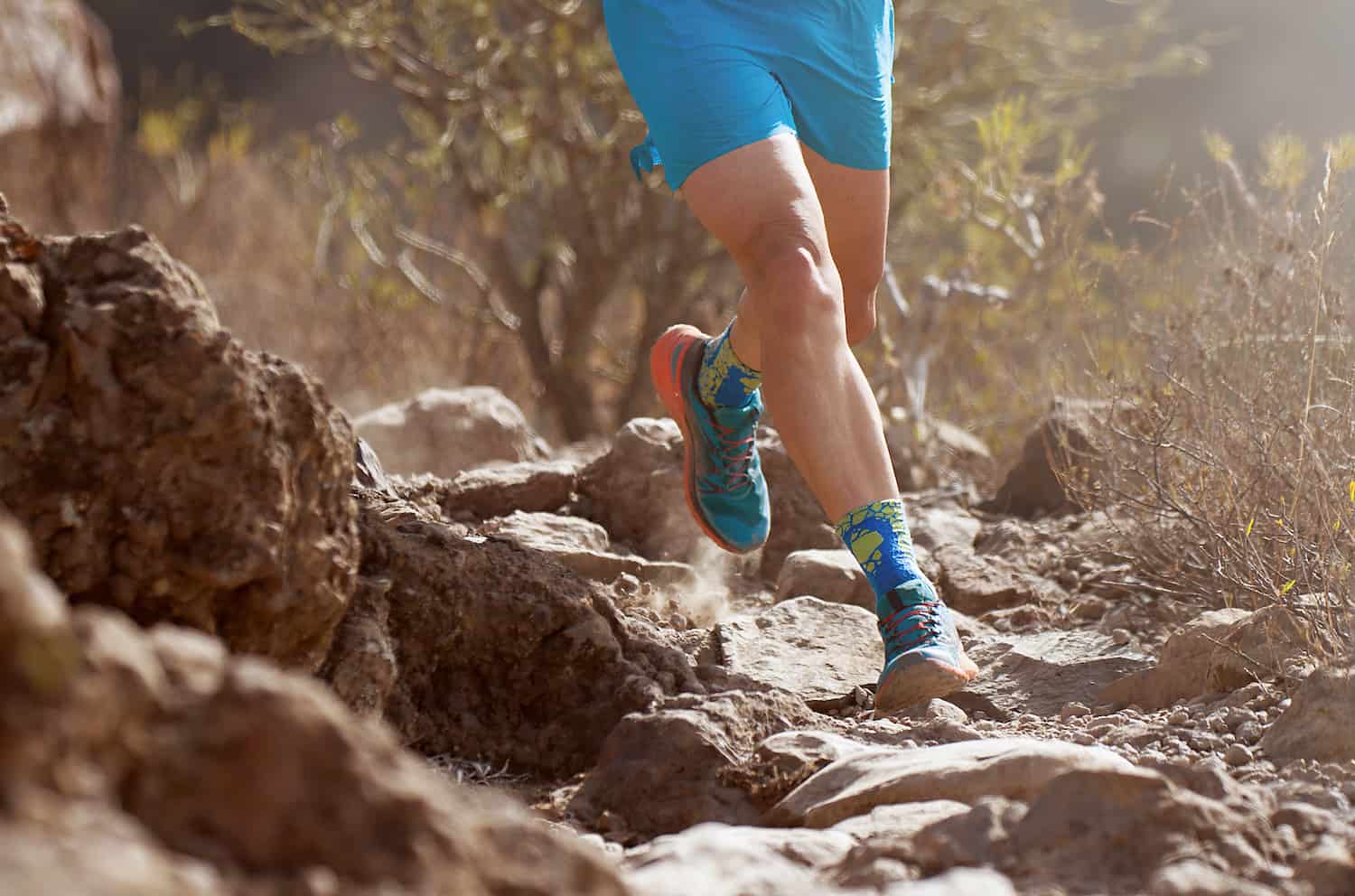
Ah, trail running! The call of nature and its breathtaking landscapes, the rugged paths where every muscle is alert, ready to adapt to the slightest obstacle! Whether you want to rediscover your hiking trails in a new way or simply spice up your daily road running routine, trail running has plenty to offer!
However, trail running requires a minimum of preparation to deal with various conditions that can change drastically from one outing to another. Shoes are by far the most important equipment you’ll need to start with.
In this article, we review what trail shoes are, the important criteria that differentiate the models, the main categories of trail shoes, and our tips to help you choose.
What Are Trail Shoes?
These shoes are made for running in natural environments on dirt paths and hiking trails. Most trail routes are set in forests or mountains. Trail running has gained much popularity in recent years by attracting runners who wish to combine a love of nature with running. One of the most famous trail races is Ultra-Trail du Mont Blanc, which circles Mont Blanc and spans France, Switzerland, and Italy over a total distance of 171 km.
They are ideal for running in nature. To adapt to the most demanding conditions, they have a special configuration that sets them apart from road running shoes.
Important Criteria
To choose trail shoes well, you should pay attention to the following criteria.
1. Comfort
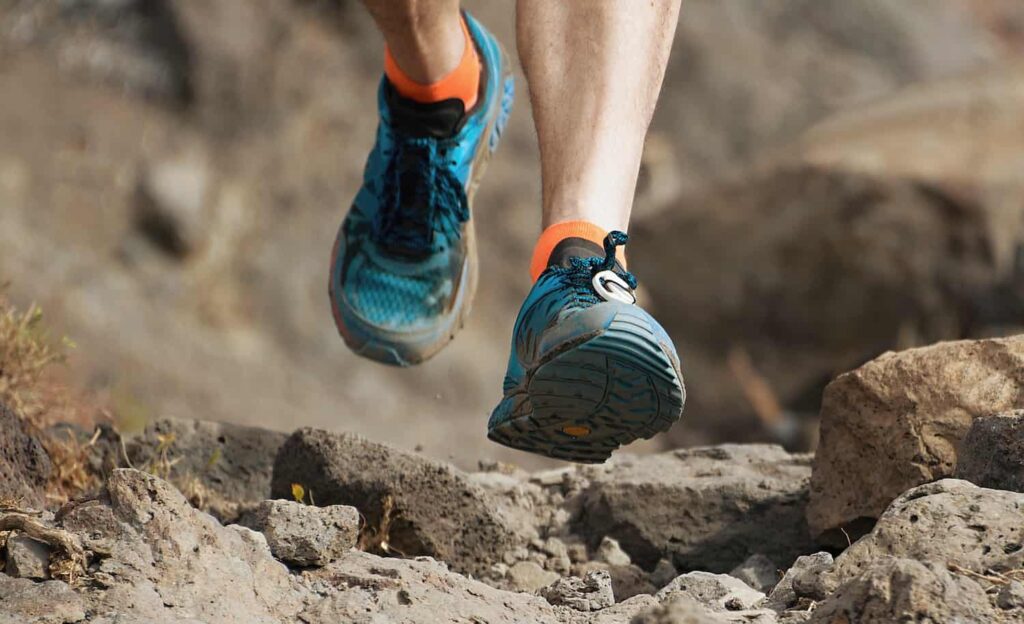
It’s proven (1): the more comfortable the shoes, the less oxygen you need when running. In other words, good comfortable shoes make you more efficient.
Many factors come into play, but it all boils down to this: you should try the shoes and ensure there is no discomfort (and especially no pain).
The fit should be precise but not too tight, and you should feel stable at all times.
Fit is one of the most important elements to determine if a shoe fits you. Even if a shoe is very popular, it will be of no use if it doesn’t fit the shape of your foot.
Moreover, a good fit is not just about length and width sizes. Feet are biomechanically complex, and a good fit must also consider other factors like foot shape and arch height.
Each brand stands out with a special shape. The best approach is to find brands that offer shoes adapted to your morphology. For example, Altra offers shoes with a spacious forefoot that suits wide feet well.
2. Grip
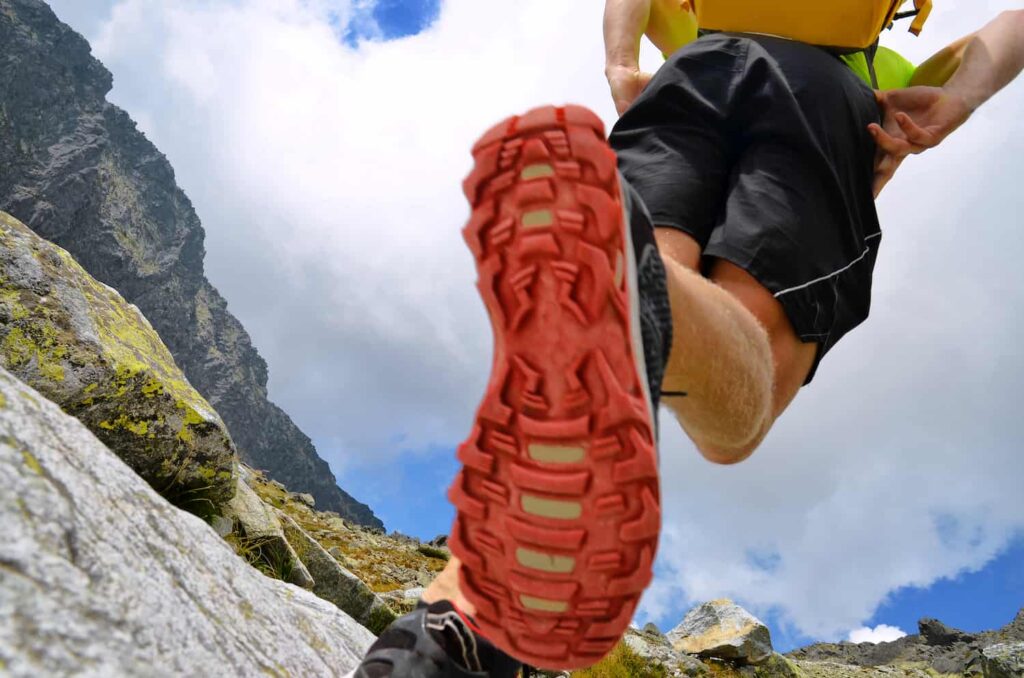
The outsole of a trail shoe features lugs for good grip on highly technical terrains, both uphill and downhill. These are often made from hard rubber (e.g., carbon rubber) for a naturally grippy and durable configuration.
Vibram is particularly appreciated for its performance and abrasion resistance. The Vibram Megagrip rubber is very popular on hiking shoes and is now also found on trail shoes. However, many brands prefer to use their own technology (e.g., Saucony, Altra).
Lug Types
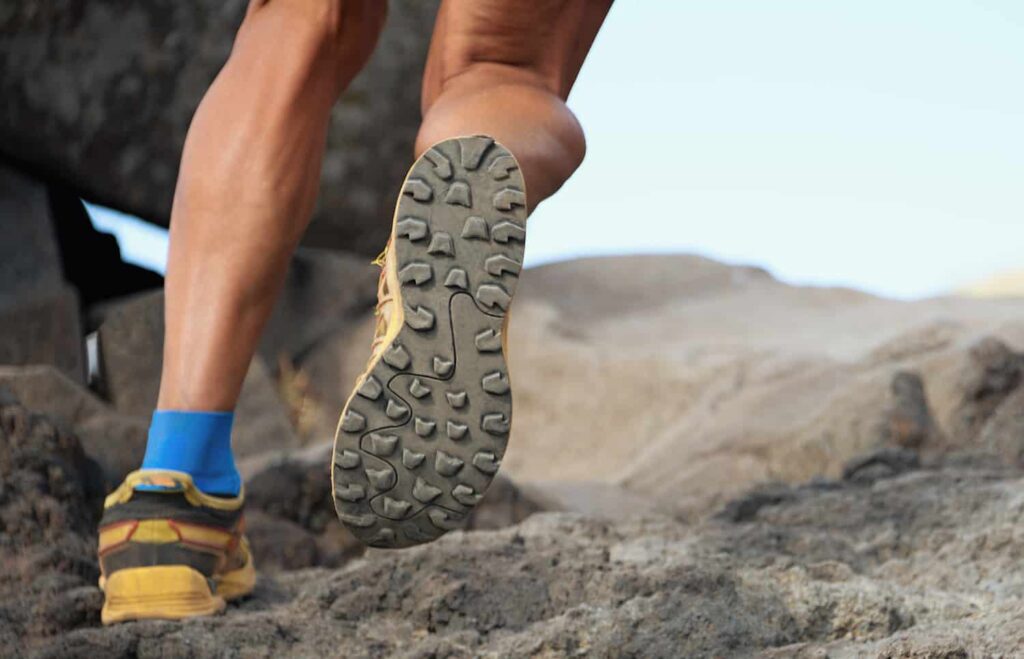
Lugs vary based on the terrain type using two criteria:
- Their depth, generally between 3 and 5 mm
- Their shape: lugs are often arrow or chevron-shaped, but they can be rounder in some cases to be compatible with road running.
Thus, there are shoes with shorter lugs for easy trails. Conversely, some models have longer lugs and a more aggressive outsole for snow.
Overall, many trail shoes aim to be suitable for ultramarathon distances and offer a versatile setup to handle most terrains. This is the case with the Hoka Speedgoat 6, one of the most popular shoes. This trail shoe features a versatile design with 5 mm lugs on its outsole to ensure good traction on slopes, including muddy and snowy grounds.
3. Stability
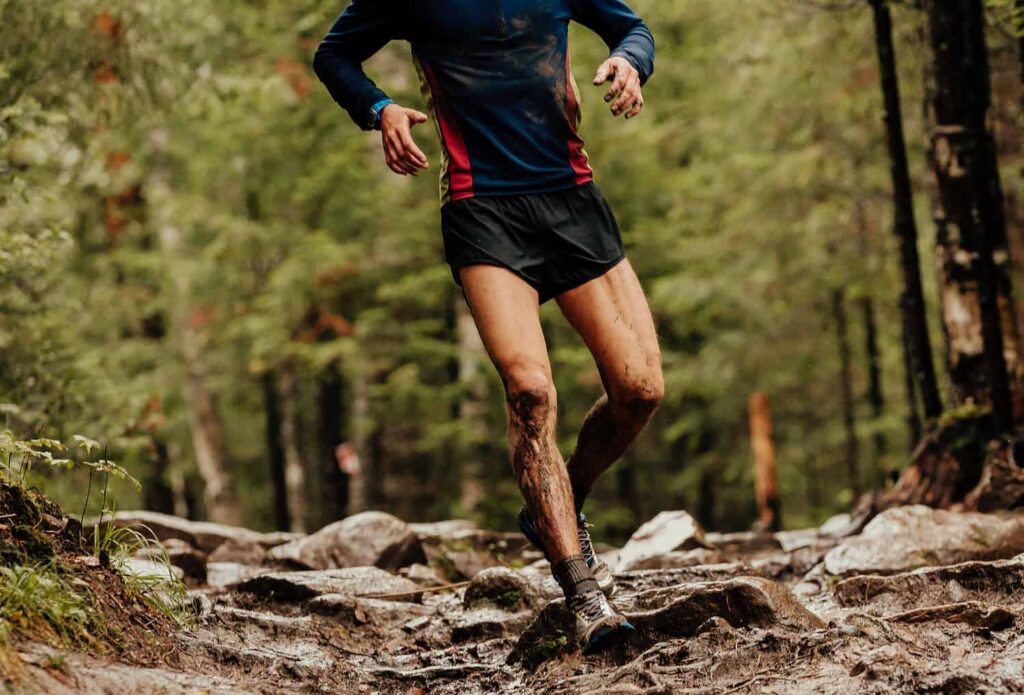
Stability combines the shoe’s grip and foot support. If the outsole isn’t grippy enough for the terrain you intend to tackle, you risk slipping and losing balance.
Similarly, if foot support between the shoe’s upper and platform isn’t tight enough, your run may be unsteady on uneven terrain, risking an ankle twist. Additionally, good support involves sizing that fits the length and shape of your foot. Like hiking shoes, leave a bit of space between your toes and the shoe tip as your foot will slide downwards on slopes.
4. Protection
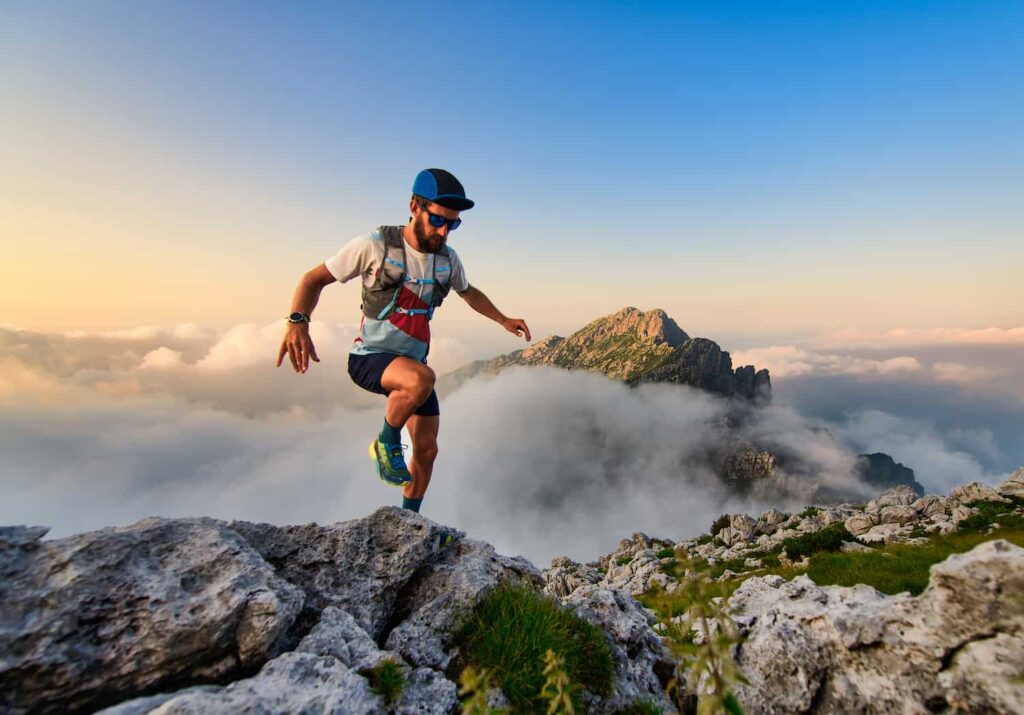
Who hasn’t stubbed their toe on the corner of a table? Imagine the same thing at full speed with a rock or a sneaky root. Trail shoes protect the foot from potentially dangerous obstacles one might encounter in nature, especially in wild and poorly marked areas. For instance, they almost always feature a toe bumper at the front.
While the midsole is often sufficient for a comfortable run, some shoes are also equipped with rock plates for added comfort and safety. This is essential if you intend to run mostly on rocky terrains.
Additionally, the upper of a trail shoe is sturdy to prevent tears from impacts and scrapes. It’s common to see fused or sewn reinforcement pieces for additional protection. Dense uppers offer better protection and durability, but watch out for breathability!
6. Cushioning
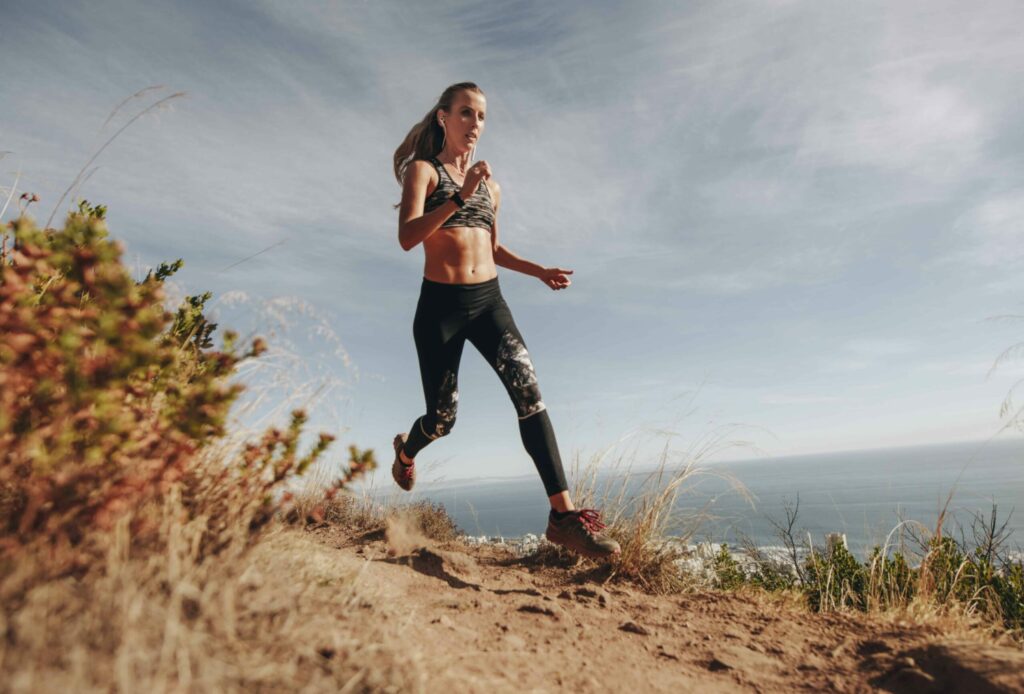
The cushioning of a trail shoe mainly depends on its midsole. It’s composed of foam to absorb shocks and make the run more comfortable, even on bumpy terrain.
The choice of cushioning level is primarily a question of preference, but it can also influence your performance in some cases. The response can vary greatly from one runner to another based on your morphology and will change as you gain experience and refine your preferences.
Ask yourself: Do I prefer to feel the ground under my feet or do I prefer to avoid shocks as much as possible?
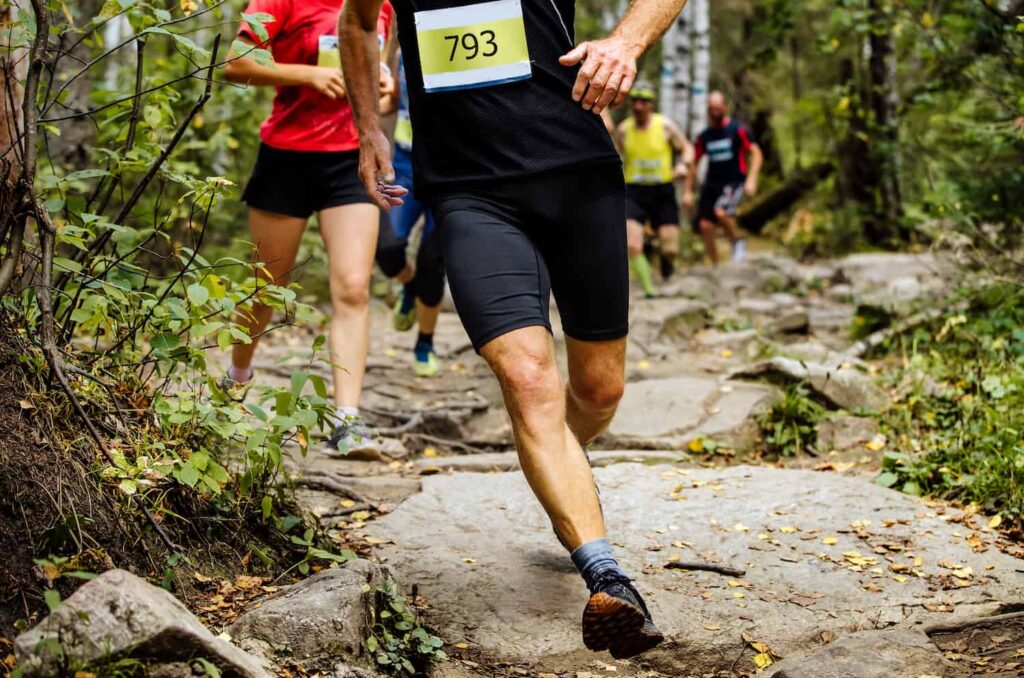
Overall, the consensus is that well-cushioned shoes are preferred for long distances, if only for comfort.
Even an athlete like Anton Krupicka, one of the icons of barefoot running early in his career, now favors heavily cushioned La Sportiva shoes. Similarly, Scott Jurek, the legendary ultrarunner, has always kept his comfortable Brooks Cascadia while being featured in Christopher McDougall’s Born to Run, even though the book is an ode to barefoot running.
Nevertheless, for shorter sessions, limited cushioning can be more tolerable. Moreover, for short-distance races, reduced cushioning may prove more effective as it can offer a more responsive ride.
What Does the Science Say?
A study (2) concluded that minimalist shoes might increase injury risk in athletes weighing over 71 kg (157 lbs). Beyond that, there would be no impact.
If it’s your first pair of trail running shoes, we recommend opting for a cushioning level similar to your road shoes. If it’s your first pair of running shoes altogether, it’s wise to choose intermediate cushioning and refine your selection later.
7. Breathability

When temperatures go up, whether it’s summer or you’re giving it your all during a mountain race, it’s always pleasant to feel a gentle breeze on your feet. Unfortunately, this is a rare experience with trail shoes because their protective upper construction has a tight weave to guard against trail debris.
If you live in a region where the sun shines and rain isn’t an issue, then you can opt for shoes with a thin and breathable upper to avoid overheating and excessive sweating on the trails.
The Brooks Cascadia 16 and Nike Air Zoom Terra Kiger 8 are great choices for optimal breathability.
8. Waterproofing
The upper of trail running shoes tends to have a closed texture to prevent water from entering the shoe. The materials also repel water and are designed for quick drying.
Trail running shoes protect against moisture with varying levels of waterproofing. Most uppers prevent small amounts of water from entering the shoe, for instance, during light rain or shallow puddles. This is often enough, especially since trail shoes dry quickly.
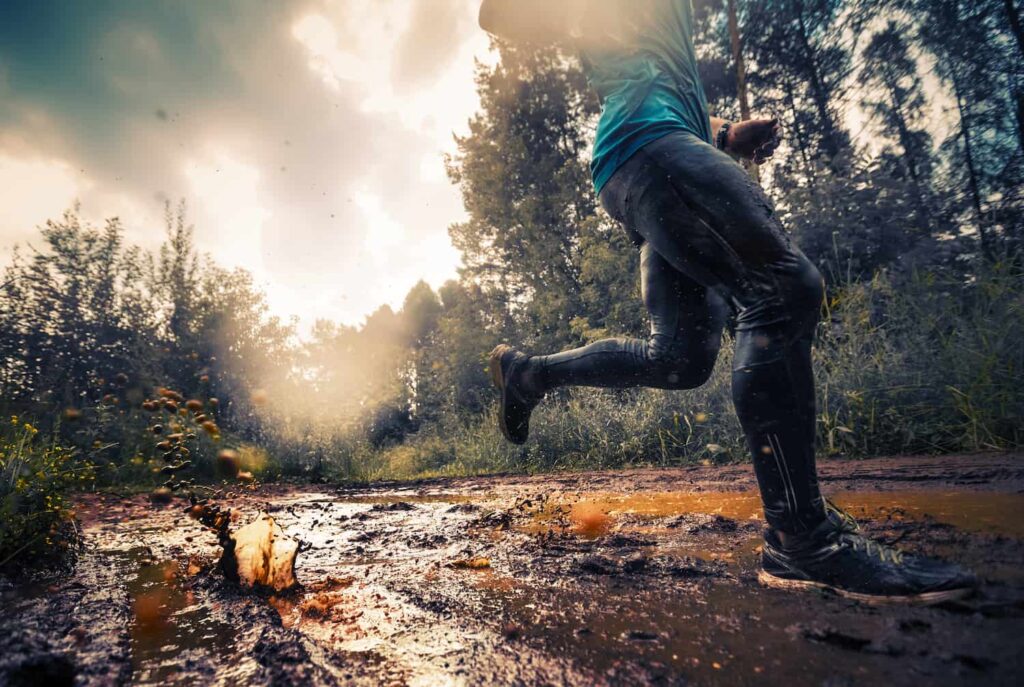
Do you live in a rainy region and are tired of having wet feet on every run? In this case, waterproof trail shoes are a must. Gore-Tex (or equivalent) can be a good solution.
However, be aware that no model is entirely waterproof beyond a certain point.
Most trail shoes (like many in our selection) are also available in Gore-Tex. However, waterproof shoes are heavier and more expensive. For these reasons, we don’t necessarily recommend them.
9. Drop
The heel-to-toe drop determines the elevation of your heel relative to the forefoot. If a shoe measures 30 mm at the heel and 26 mm at the front, the height difference is 4mm.
Trends in drop levels change like seasons. High drops (10-12 mm) were very common, but in recent years, more and more brands have opted for lower inclines (e.g., 5 mm).
And, of course, there’s Altra Running, which only offers zero-drop shoes because they claim it’s the only configuration that respects the natural position of the foot and the human body’s overall anatomy.
Ultimately, the relationship between heel and drop is tied to comfort. There’s no absolute truth, so it’s a personal preference. The only randomized controlled study conducted so far concluded that there were no significant differences in injury risk between different drop levels (4).
Our advice: choose something standard (6-8 mm) and go from there. As you gain experience, you might find that a lower drop is more comfortable for you, or the opposite.
And What About Running Gait?
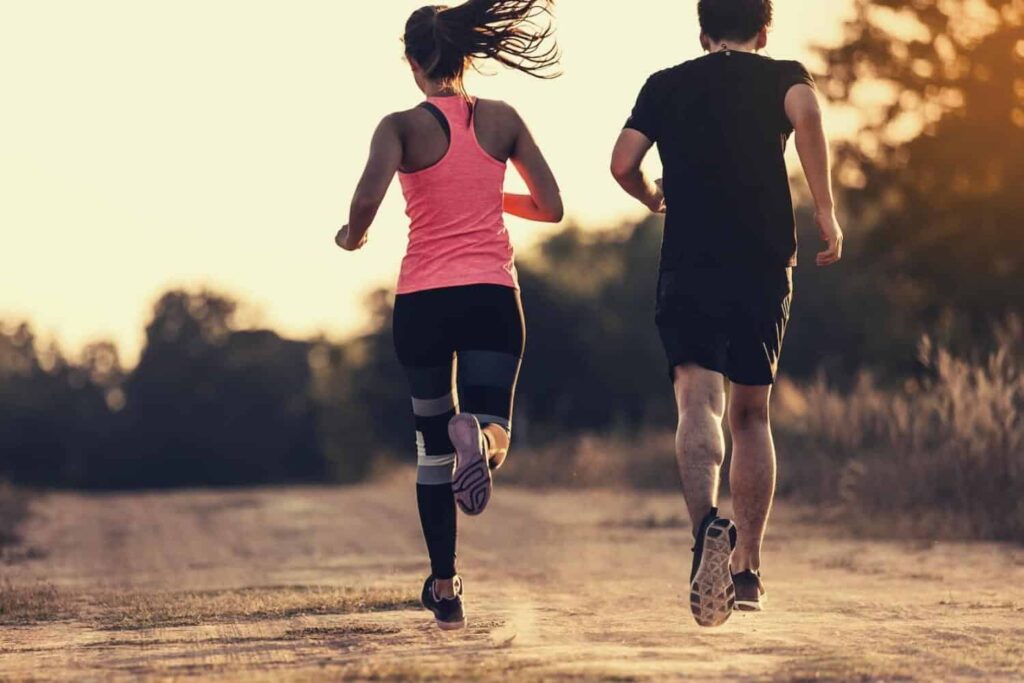
Running gait can be an important parameter for road running shoes. There are neutral and pronation models according to the movement of your foot during running.
For trail shoes, things are simpler. There are simply little to no shoes made specifically for pronation.
However, a trail shoe is inherently stable as it provides precise foot support with a sufficiently rigid platform. Thus, your running gait issue is less of a concern. However, if you have overpronation issues on the road, you’ll need to be careful to choose an even more stable model. Orthotics can help in some cases; always consult with a health professional if you have any doubt (e.g. podiatrist, physical therapist).
Types of Trail Shoes

The choice of your trail shoes will depend on the types of trails you plan to run on (e.g., dirt paths, mountain trails) and the practice types you intend to use your shoes for (e.g., training, competition).
Trail-running shoes can be divided into three main categories.
Hybrid Shoes
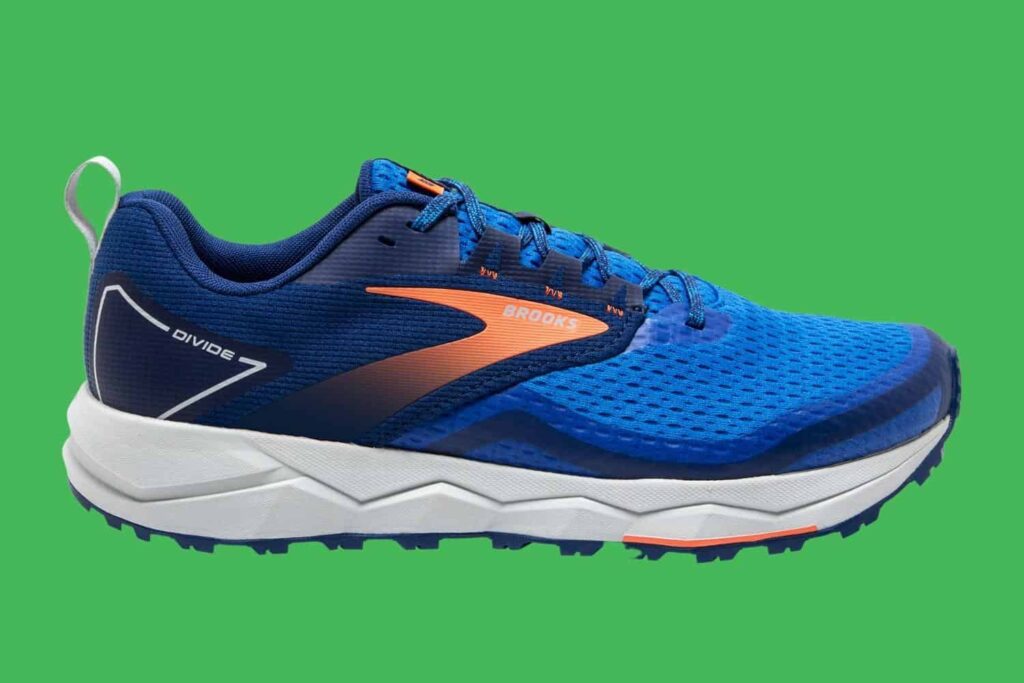
A hybrid trail shoe aims to suit both road and easy trail paths. It’s a good choice if you live in the countryside and frequently alternate between asphalt and dirt roads.
This is the case, for example, with the Brooks Divide (pictured above), which aims to suit both road and lightweight terrain. The New Balance Fresh Foam Hierro is another example of such a shoe.
However, the downside of these shoes is apparent: they can do everything but not as well as shoes dedicated to each activity. In fact, there are quite few, reflecting their low popularity.
Lightweight Trail Shoes

Lightweight trail shoes are designed for relatively uniform and dry natural surfaces. Think dirt roads, gravel paths, and well-cleared forest trails.
As a result, these shoes have shallow and less aggressive lugs, which is enough for easy to moderately difficult trails.
Pros
Cons
Examples of lightweight trail shoes: Salomon S/Lab Pulsar, Saucony Peregrine, Altra Superior.
Ultrarunning Trail Shoes

These could also be called technical or robust trail shoes. This type of shoe aims to allow you to venture onto the toughest terrains, especially in the mountains.
These shoes are sturdy and high-performance with a reinforced design to protect your feet and last long without tearing or developing holes in the sole.
Consequently, you’ll find a sturdy upper with a relatively closed design to prevent water from entering the shoe. These models are typically available in Gore-Tex versions.

The outsole features powerful lugs with an aggressive pattern for optimal grip in all conditions. Some pairs even have a rock plate to ward off sharp or pointed obstacles.
Regarding cushioning, ultra trail shoes have high-stack soles to cushion shocks over long distances. Not all trail runners need this, but it’s generally appreciated for comfort, even at the end of the course after hours of running.
Lastly, note that these shoes mostly have good rigidity (like hiking shoes) for better stability on difficult trails. However, this rigidity can vary from model to model.
Pros
Cons
Examples of ultra-trail shoes: Hoka Speedgoat (pictured above), Salomon Speedcross, Brooks Cascadia.
Final tips
You now know the main criteria to look out for when buying trail shoes and the main categories of models with their pros and cons.
We’d like to conclude by giving you some valuable tips based on our experience and feedback from our readers.
1. Alternate Pairs
As proven by a 2015 study (3), alternating pairs of running shoes can reduce the risk of injury. The mechanism isn’t apparent, but one might assume that habituating your body to running with different shoe types allows it to adapt better.
For example, a good solution is to go for a model for daily training and another for your official races or faster sessions.
There’s no reason to hold back if you plan to practice trail running in the long term because a good trail shoe will last at least 500 km. Alternating will only delay the moment you need to replace your shoes.

2. Seek Professional Advice
Let’s be honest: not all salespeople are equal. However, some are treasure troves of information and take pleasure in sharing their experience with their clients.
By explaining what you’re looking for, they can guide you to the ideal shoe.
Over time, they can refine their recommendations based on your feedback.
Moreover, running/trail running coaches can also help in your equipment search. They’re best placed to assess your practice and can offer you insightful advice as they know you personally.
Lastly, some podiatrists are very competent and know the various shoe models well enough to steer you in the right direction if you need help.
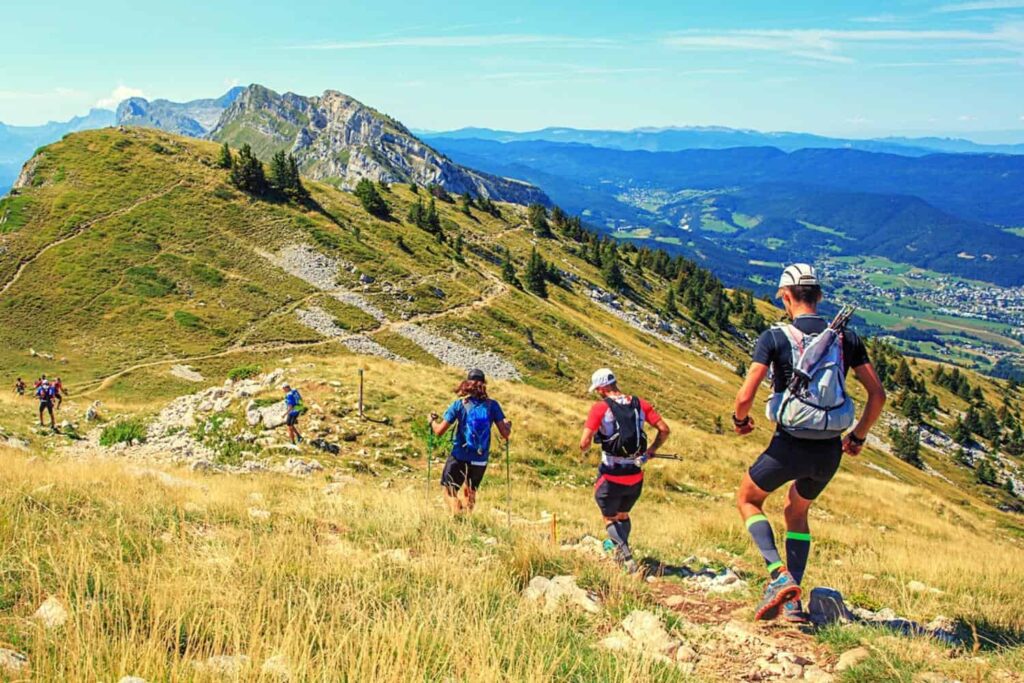
3. Wait for Sales
Budget can be an essential criterion when choosing your shoes. A good pair of trail shoes can easily cost around $150 new (even more now with tariffs!). It’s significant, especially if you’re starting and unsure about what you need (or even if you’ll commit to trail running long-term).
Fortunately, brands release new versions of their shoes yearly, and it’s common to find older ones at discounted prices. Thus, finding a great model for under $100 during sales is quite possible!
You now know the key points to pay attention to when choosing your trail shoes. To go further, we invite you to check out our selection of the best trail shoes to discover universally acclaimed models.
References
Improved footwear comfort reduces oxygen consumption during running
Luo et al. (2009). Footwear Science.
https://www.tandfonline.com/doi/abs/10.1080/19424280902993001
Heavy runners risk injury in lightweight running shoes
University of South Australia (2017)
https://www.unisa.edu.au/Media-Centre/Releases/2017-Media-Releases/Heavy-runners-risk-injury-in-lightweight-running-shoes/#.Wlc5ulWnFhH
Can parallel use of different running shoes decrease running-related injury risk?
Malisoux et al. (2015). Scandinavian Journal of Medicine.
https://pubmed.ncbi.nlm.nih.gov/24286345/
Influence of the Heel-to-Toe Drop of Standard Cushioned Running Shoes on Injury Risk in Leisure-Time Runners A Randomized Controlled Trial With 6-Month Follow-up
Malisoux et al. (2016). The American Journal of Sports Medicine.
https://journals.sagepub.com/doi/abs/10.1177/0363546516654690