
Brooks Hyperion Max 4 Review: The Best Daily Trainer? (2026)

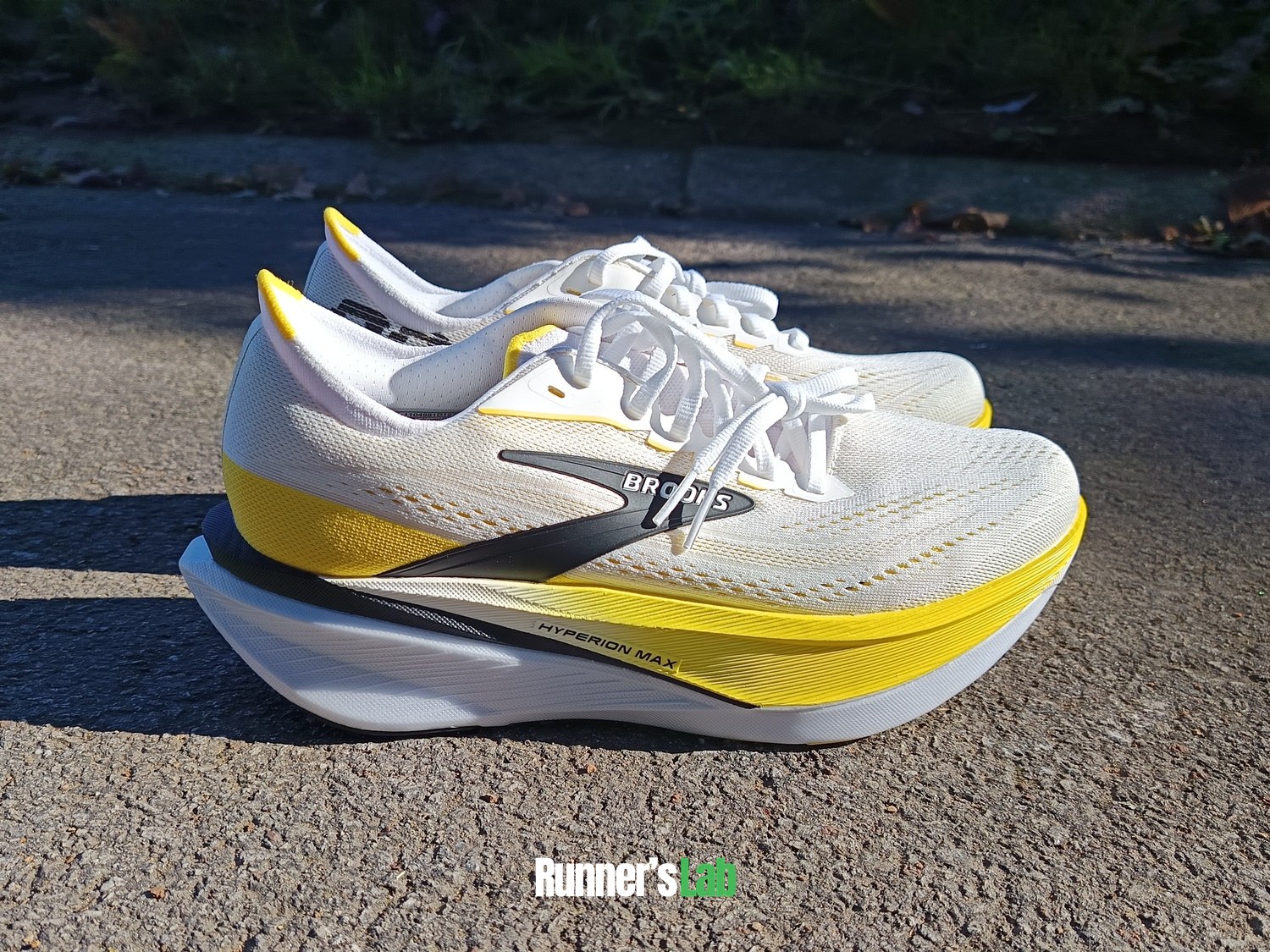
Maximalist shoes have become the norm today. Brooks has recognized this trend and offers “Max” versions of most of its iconic lines, providing even more height and cushioning for runners who want it.
The Hyperion line is much older than the number 4 suggests: it has always been associated with speed and racing at Brooks. It was redesigned and reorganized a few years ago, which is why it has a new numbering system. For road running, the lineup also includes the Brooks Hyperion 3, designed for daily training, and the Brooks Hyperion Elite 6, featuring a carbon plate, for racing.
With the Hyperion Max 4, Brooks enters a highly competitive market, that of “super shoes” for training, with a challenging mission: to compete with flagship models that have won widespread acclaim, such as the Asics Superblast 3. To achieve this, the brand has made a bold choice: to offer a shoe that’s quite different from its direct competitors.
Is it up to par? Does it match your runner profile and goals?
That’s what we’ll find out in this comprehensive review.
Why trust me?
With a personal best of 2:38 in the marathon and a substantial weekly training volume, I test many different models of running shoes to help my running.
I conducted my field test of the Brooks Hyperion Max 4 during various types of workouts to evaluate its comfort and ride feel. I also consulted with other runners of varying skill levels to validate my impressions and ensure that my recommendations will be useful to as many people as possible.

Our Verdict
A very good training shoe with firm, responsive cushioning, built to last.
- Weight: 283 g / 10.0 oz in men’s EU 42 (257 g / 9.1 oz in women’s EU 40)
- DNA GOLD and DNA FLASH v2 foams, SpeedVault nylon plate
- Height: 45 mm (heel), 39 mm (forefoot)
- Drop: 6 mm
- Fast workouts, racing
This new Hyperion is quite heavy, as the focus has been on impressive durability. It also offers a noticeably firmer feel upon impact. That doesn’t make it uncomfortable, though, and if you’re tired of plush shoes, the Max 4 is definitely worth checking out.
With its impressive height, shock absorption is excellent for going longer. In terms of responsiveness, the weight is noticeable, and the firmness limits bounce. Despite this, the combination of DNA GOLD and DNA FLASH v2 foams with the nylon SpeedVault plate delivers very good responsiveness across a wide range of paces.
As is often the case with Brooks, the jacquard-knit upper is very well-designed, offering excellent lockdown and comfort. The outsole has SpeedTack rubber in strategic areas for reliable traction on all surfaces.
All in all, the Hyperion Max 4 stands out from the competition with a different feel. Its performance is very good, although its weight can be noticeable at higher paces.
Pros
- Ideal for long runs that include sections at marathon pace
- Very comfortable upper with a secure lockdown
- A versatile training shoe, designed to rack up the miles
- Reliable traction on all surfaces
- Excellent stability for a shoe this tall
Cons
- Firm cushioning for some runners
- A shoe that’s fairly heavy for its category, with less responsiveness than some of its competitors
- Not all testers were satisfied with the fit and breathability
Firm but Protective Cushioning
The midsole of the Brooks Hyperion Max 4 is identical to that of the previous version. It features:
- Upper layer: DNA GOLD foam
- Lower layer: DNA FLASH v2 foam (nitrogen-injected)
- Between the two: a SpeedVault nylon plate
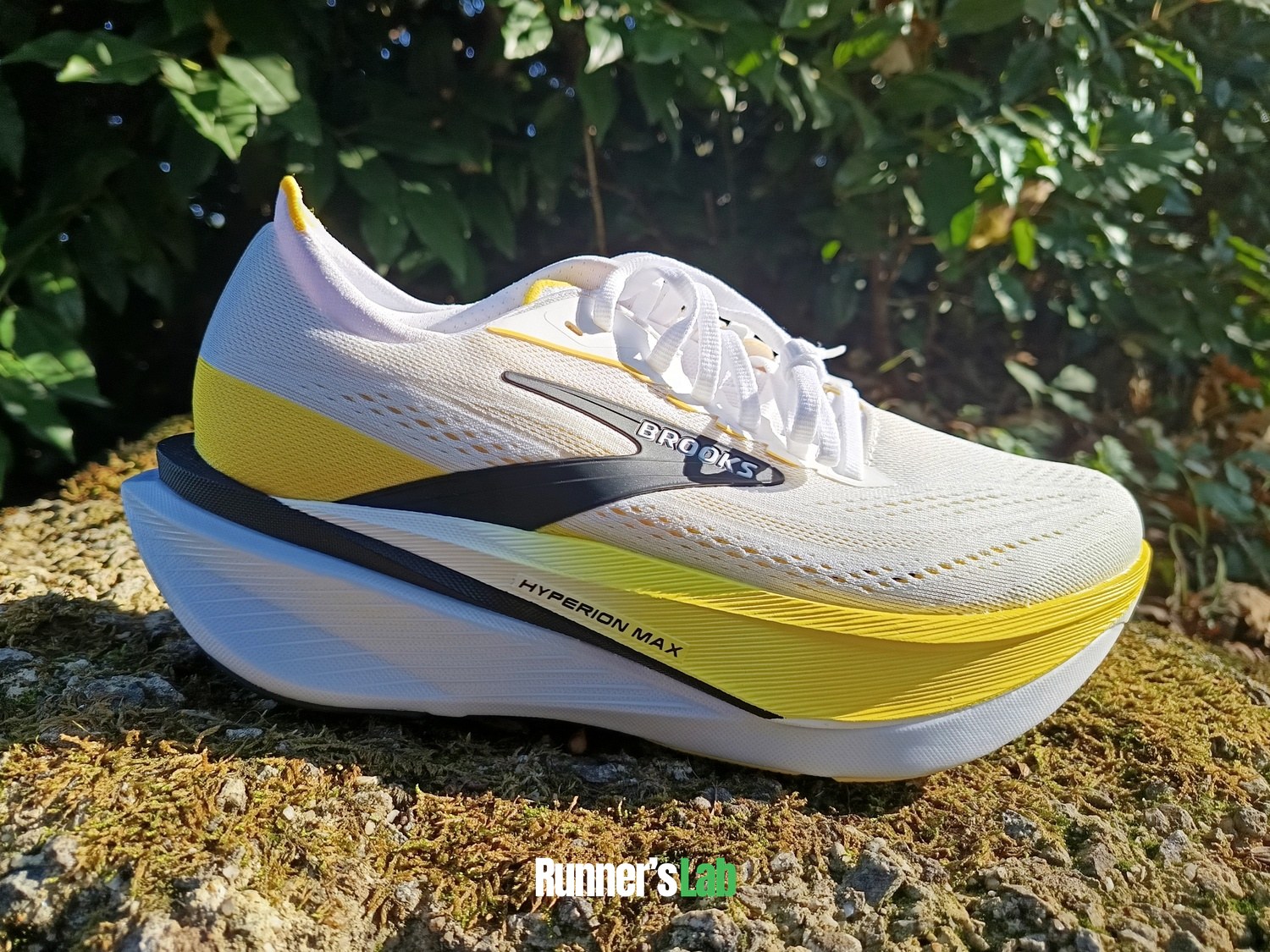
The DNA FLASH v2 foam is made of supercritical EVA. It absorbs impacts from the ground while letting the plate compress well. It also provides the shoe with excellent stability.
DNA GOLD, made of Peba, offers responsiveness, a key feature for a shoe designed for dynamic paces. The nylon plate also provides propulsion, while being less demanding and less rigid than a carbon plate.
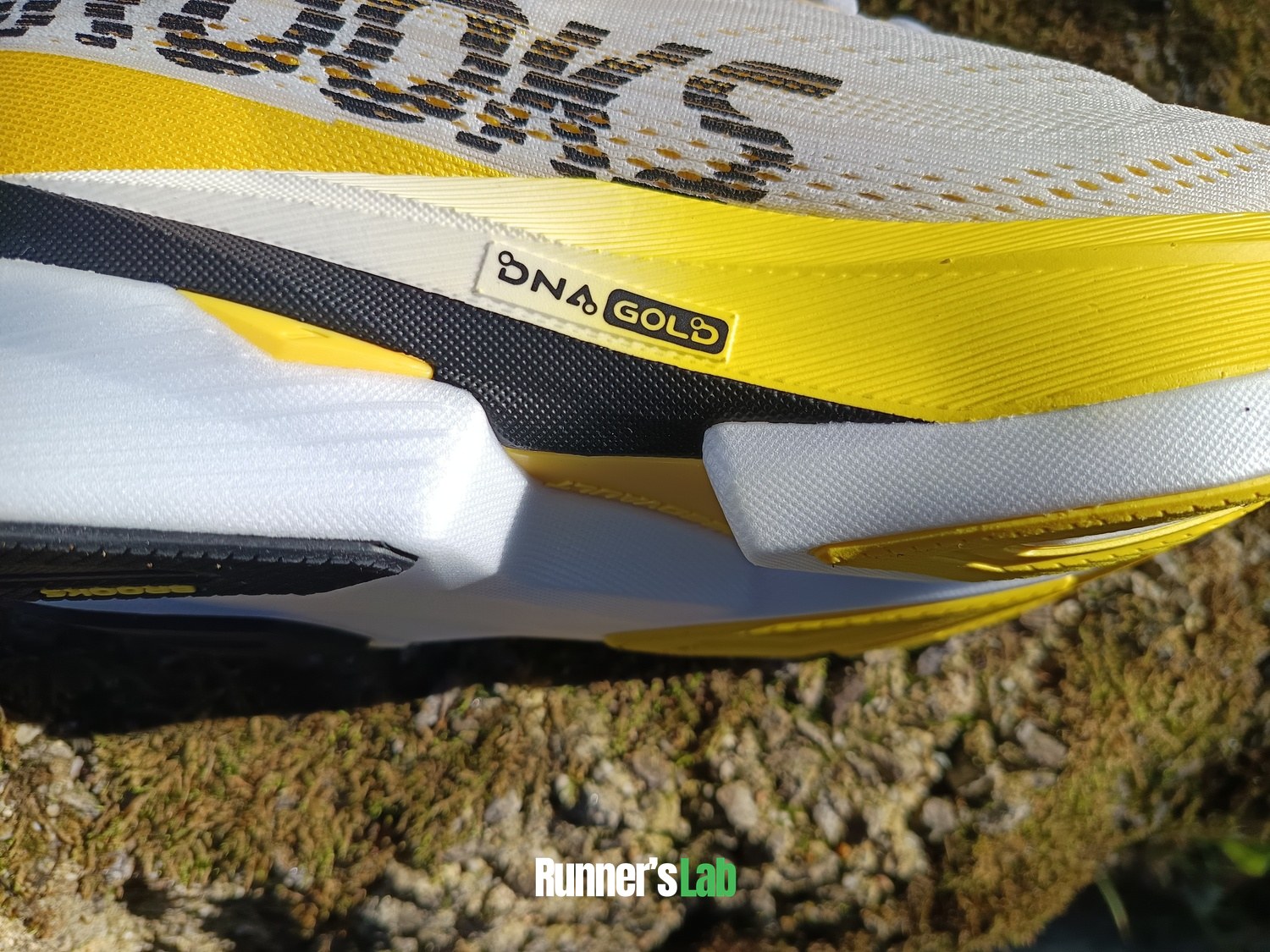
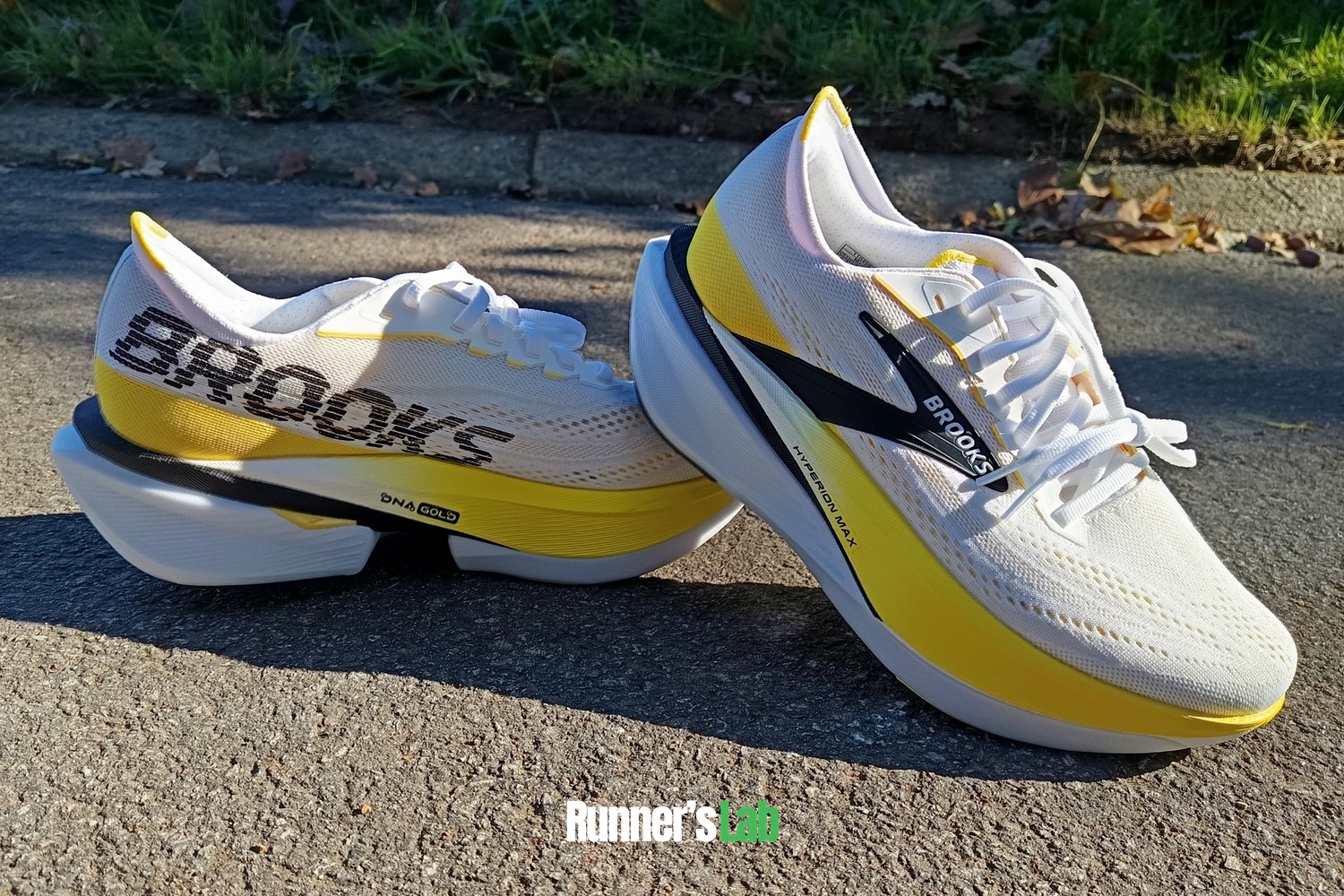
The stack height is impressive, with 45 mm under the heel and 39 mm under the forefoot. As you’d expect, shock absorption is excellent, allowing all runners to run longer confidently.
In my opinion, there are no restrictions on runner weight or stride type. With 39 mm of cushioning in the forefoot, there’s a lot of foam, and I particularly appreciated that. If there’s any limit to increasing your mileage, it certainly isn’t due to the cushioning.
It’s more about the feel upon impact, which remains fairly firm. If you like that, you’ll be able to take the shoe all the way to the marathon without any problems. If you prefer a plush feel, the distances you can comfortably run will be more limited.
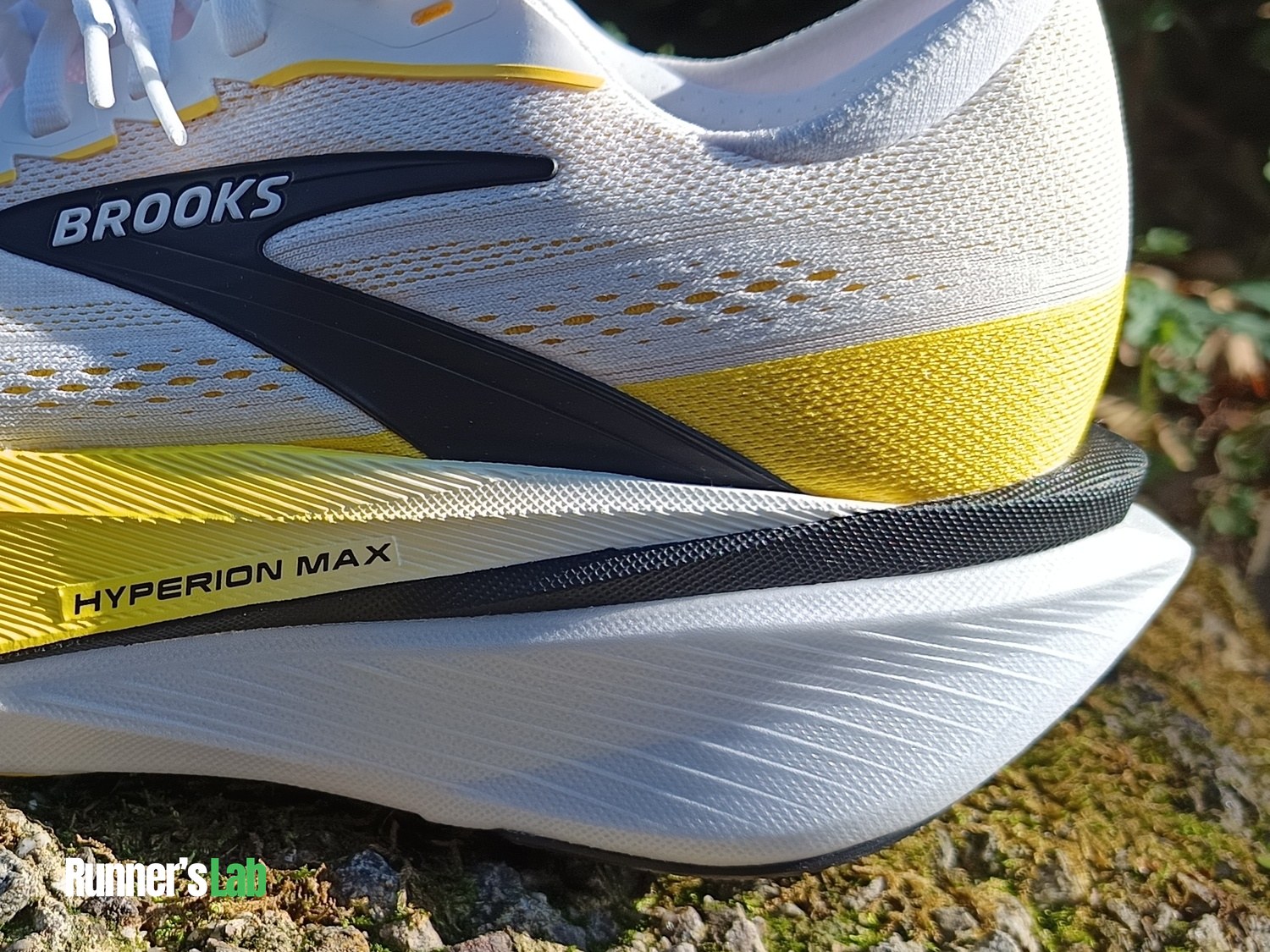
I’m in a pretty good position to talk about this: generally speaking, I don’t like firm cushioning, I often feel like I’m pounding the ground, which I don’t find pleasant. That’s not the case with the Hyperion Max 4. I liked the ground contact: firm, but soft enough to run comfortably.
One last thing: the 6 mm drop may take some getting used to if you’re accustomed to drops of 8 to 10 mm.
Good Responsiveness Despite Its High Weight, Thanks to the Plate and Rocker
Weighing 283 g / 10.0 oz in EU 42 (257 g / 9.1 oz in EU 40 for the women’s version), the Brooks Hyperion Max 4 isn’t light: it’s actually one of the heaviest in its category. We understand the brand’s desire to offer a training shoe with exceptional durability, but this is clearly a drawback.
Despite this, the Peba foam combined with the plate provides good responsiveness, and accelerating is no problem at all. The shoe is also quite versatile across different paces: the fairly firm feel and short ground contact time make it efficient on sharp accelerations.
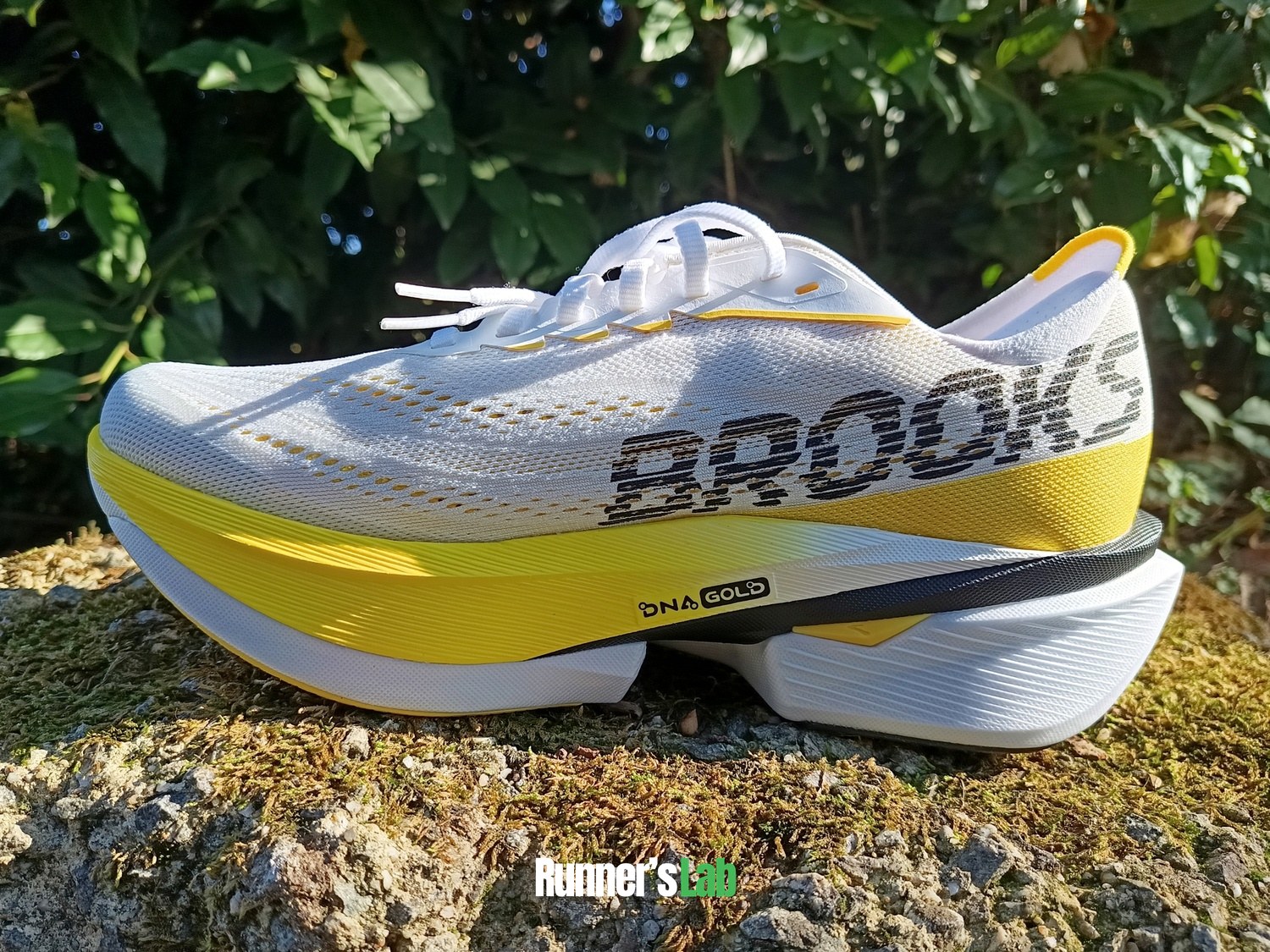
RapidRoll Rocker technology creates a curved geometry at the heel and toe. Transitions are smooth and fast, and forward propulsion is efficient.
All these features help offset the high weight and give the Hyperion Max 4 very good responsiveness. It remains slightly less responsive than some competing models, with a different feel that will find its audience.
A Neutral Shoe That’s Naturally Very Stable
The shoe is designed for a neutral stride and does not feature any stabilization technology. However, it is naturally very stable: the firm foam, wide base, and good traction ensure a safe ride.
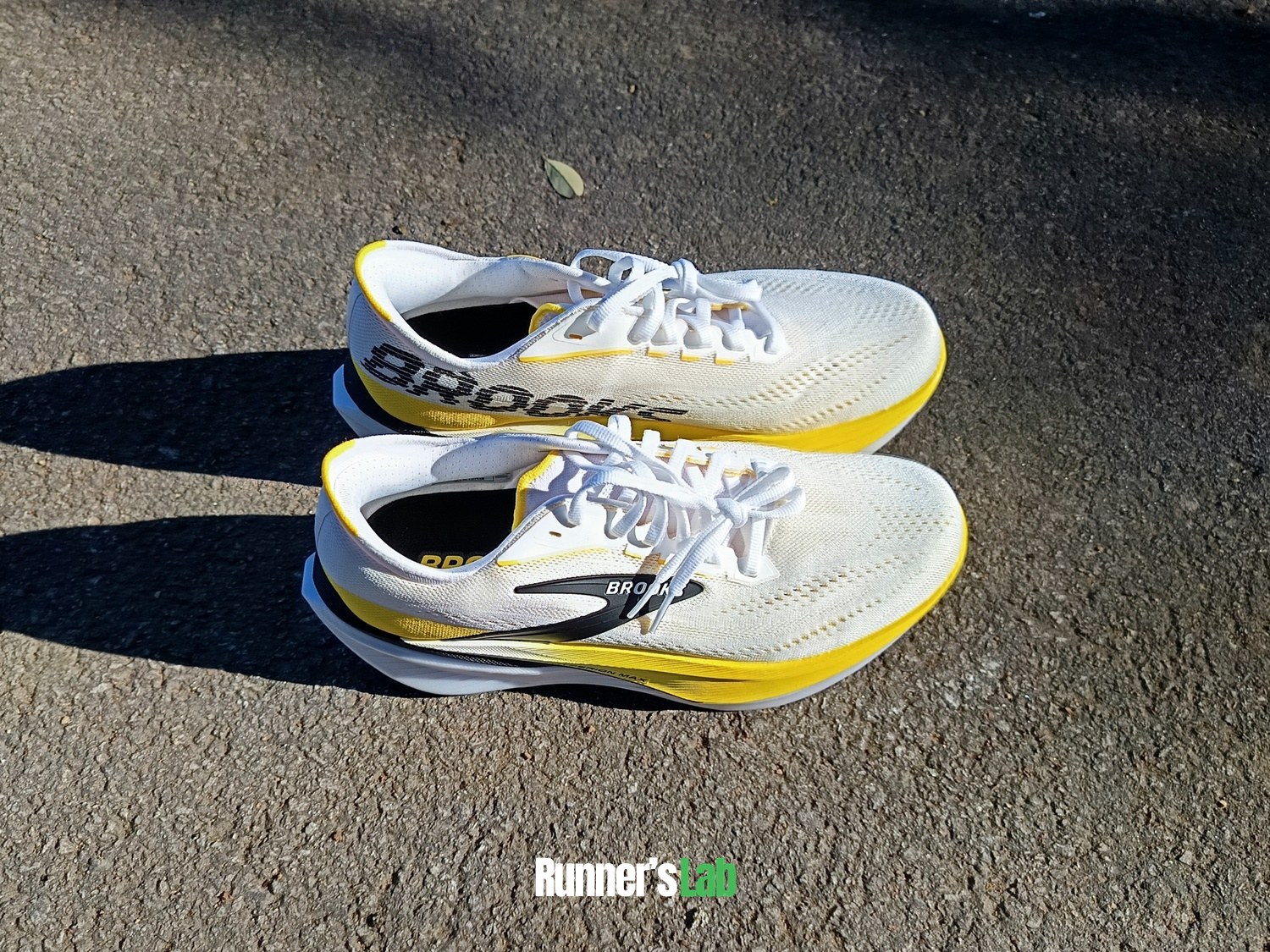
A New Jacquard-knit Upper That Fixes the V3
This new version definitely needed some changes, and they’re focused on the upper. If there’s one area where Brooks unquestionably excels, it’s the upper. The brand listened to the criticism of the previous version and made the necessary adjustments.
The “bootie” upper (integrated sock-like design) of the Brooks Hyperion Max 3 (the V3) was designed for speed, but it caused issues with stability and heel hold for some runners, which is why it received some criticism.
Brooks switches the Hyperion Max 4 to a triple-jacquard knit upper, which it has already used successfully on many models. Its only limitation is well known, and it’s present here as well.
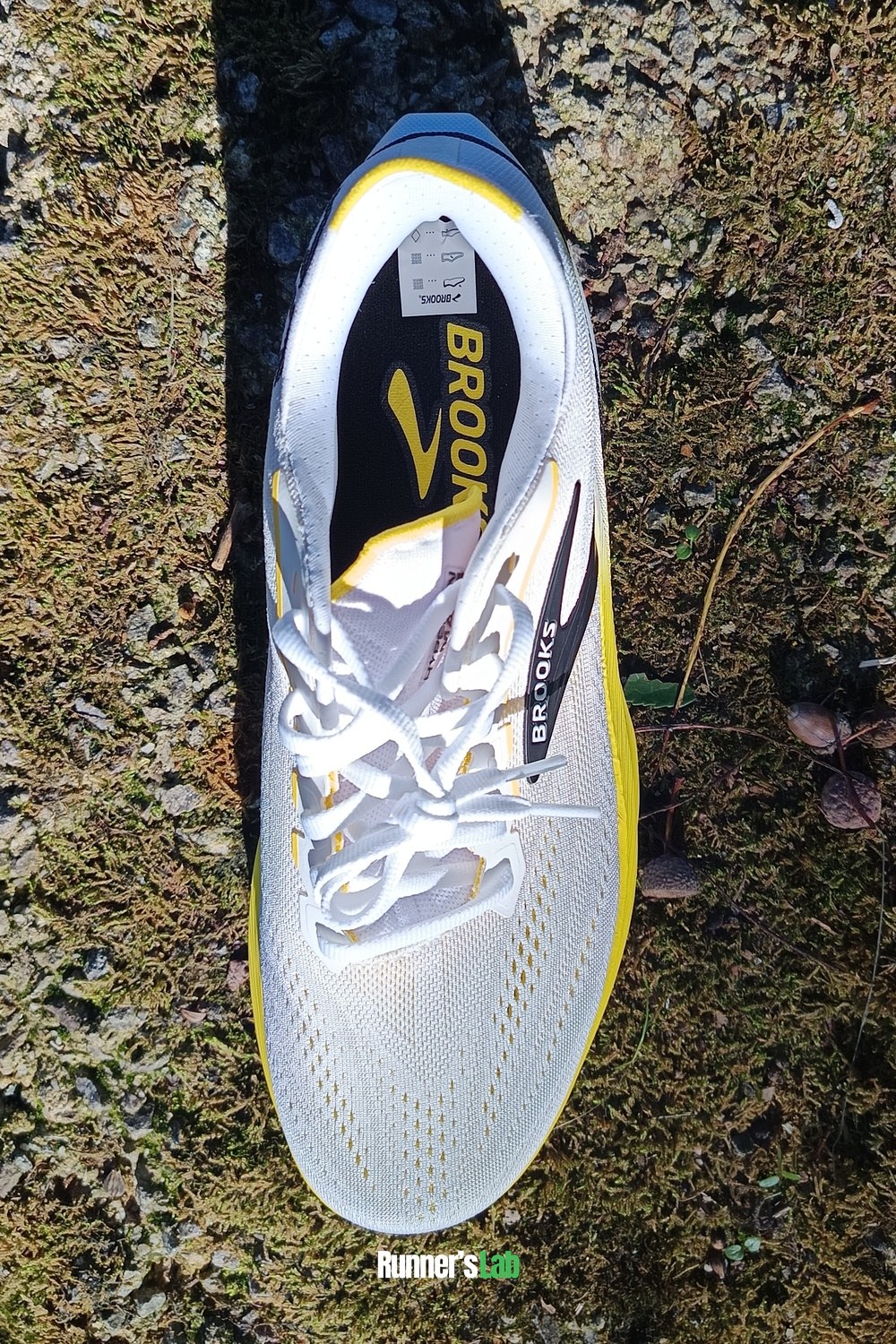
Breathability isn’t ideal with this thick fabric (especially around the toes), and your feet may get hot in the summer. On the other hand, the shoe provides excellent protection in cold weather. It dries quickly and absorbs moisture well.
No more lockdown issues: the shoe offers excellent structure, thanks to its side reinforcements, rubber side logo, and stitched internal padding. The foot is held securely in place, ensuring a safe ride.
In an effort to ensure a secure fit at all costs, Brooks has opted for a tight fit: the overall width, the forefoot width, and the toebox height are all below average.
Unsurprisingly, this is a common theme in feedback from runners with wide or high-volume feet, as well as those who like to have room for their toes. If this applies to you, going up half a size is strongly recommended.
I’ll qualify that a bit: I have fairly wide feet, and I didn’t feel cramped in the shoe. If in doubt, it’s best to try it on before buying, if possible.
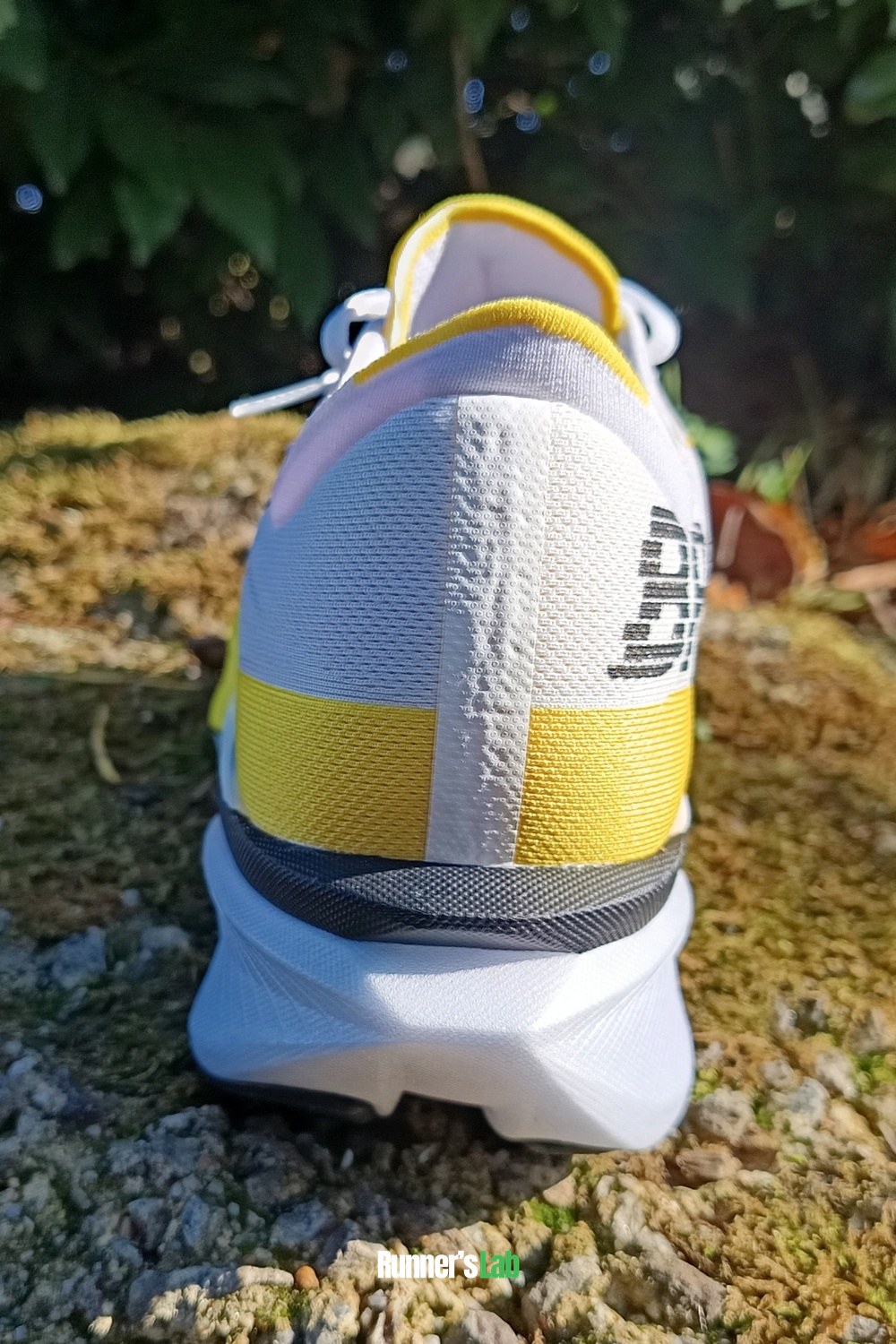
I actually found the comfort to be very good. The V3’s “slipper-like” feel is gone, but the generous padding cradles the foot nicely. I had no trouble wearing the shoe for long periods during training.
The heel counter is well-designed and rises high enough to take pressure off the Achilles tendon. Lockdown in this area is excellent, without the slippage found in the V3. The padding is generous and welcome. There is no loop for putting on the shoe.
More traditional than on the V3 (no more built-in rigid padding), the gusseted tongue moves very smoothly with the foot. Again, runners reported no slippage.
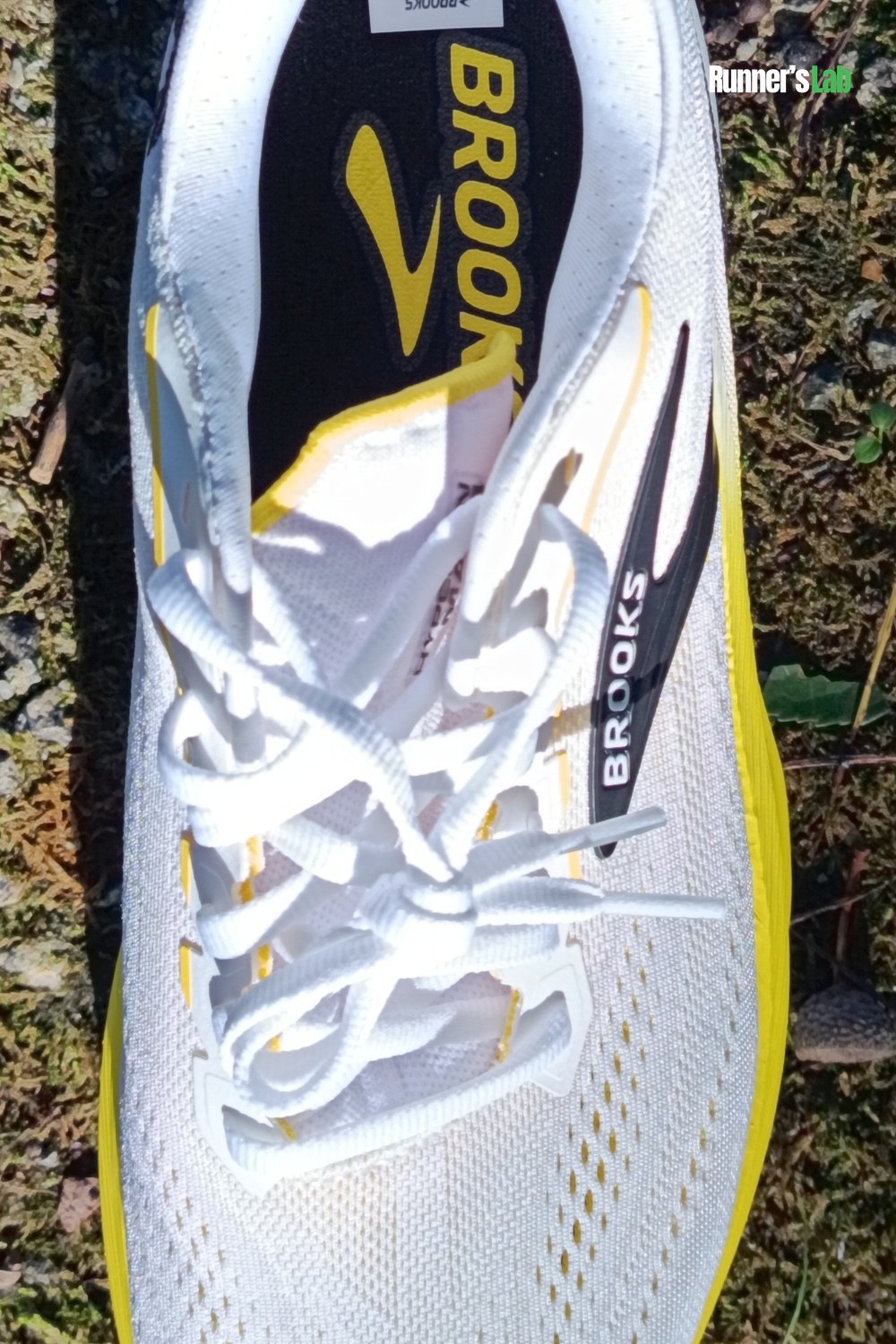
Eyelet lacing is conventional and does the job, and it lets you try different ways of lacing it. The sockliner is removable if you’d like to use your own orthotics.
Despite a few concerns about breathability and fit, the upper is, overall, very well made and is one of the shoe’s strong points.
A Thick Layer of SpeedTack Rubber
The outsole features exposed foam in the center, with a large cutout in the middle that reveals the plate and ensures good flexibility.
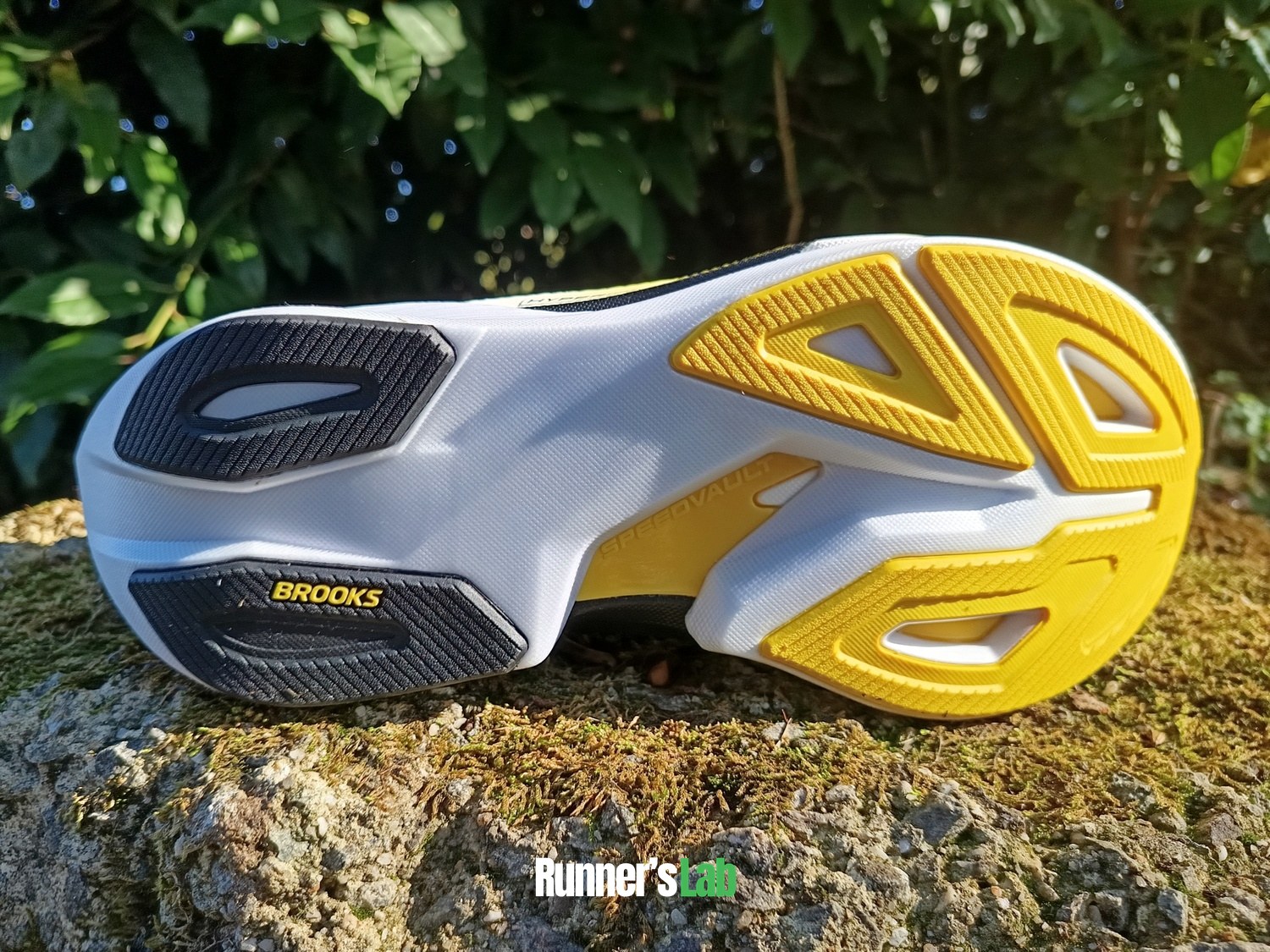
In the high-impact areas, a thick layer of SpeedTack rubber covers the heel, midfoot, and forefoot. It is so thick that it alone must add to the shoe’s weight on its own.
It is hard to wear through, hence the very long lifespan. Traction is also excellent. Even on wet surfaces, grip is excellent, and there is no risk of slipping.
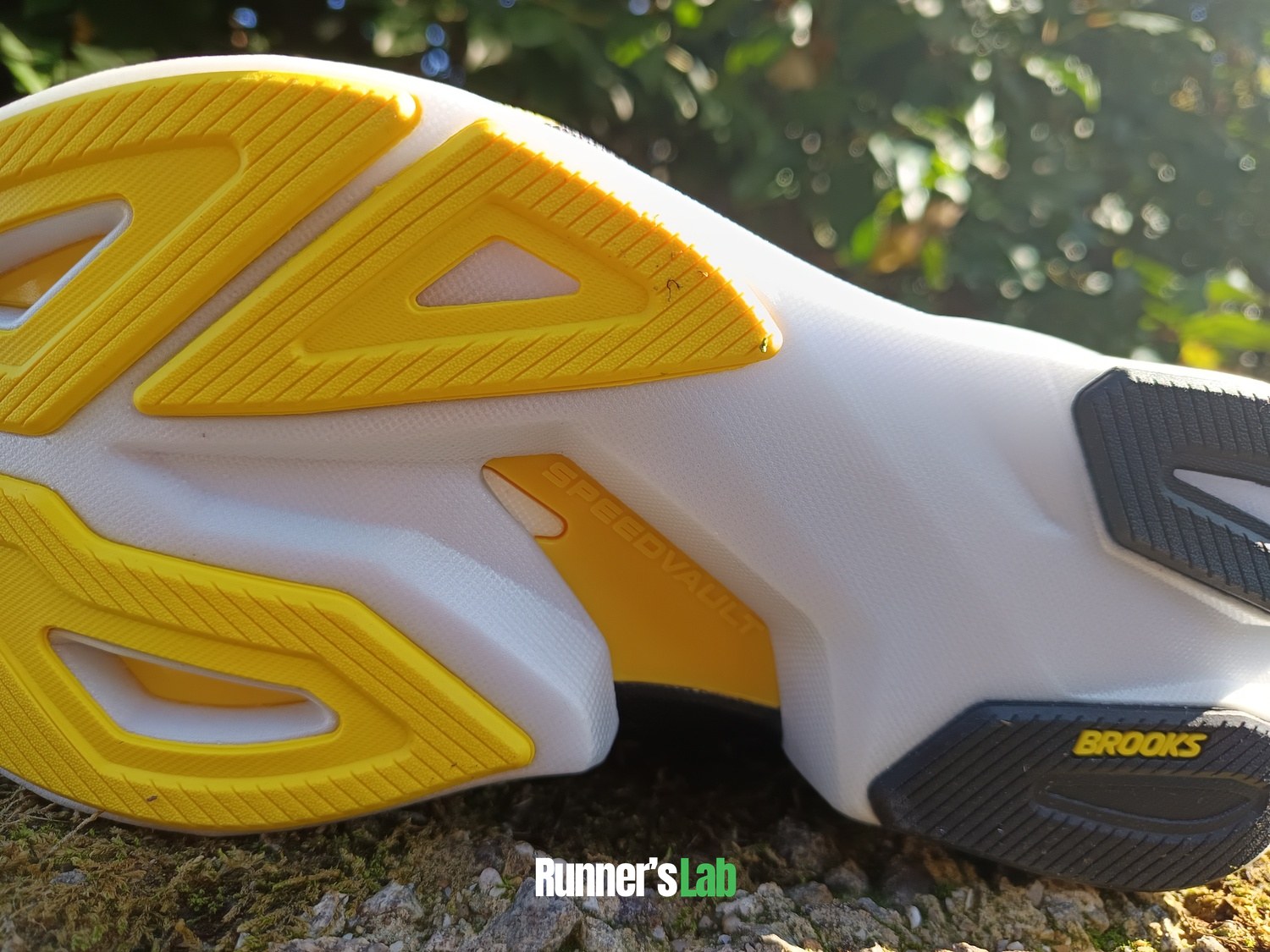
You can take it on regular dirt paths without any problem, but it is inevitably more limited on technical sections, especially since debris can easily get lodged in the central cutout.
Who Is It For, and for Which Workouts?
The Hyperion line is primarily designed for speed and uptempo running. However, its max-stack dimensions provide plenty of cushioning and open the shoe up to a wider range of training uses.
Increasing the distance isn’t a problem, as long as you can tolerate the firmness of the shoe, which can cause a pounding sensation after 25 to 30 kilometers.
The shoe is therefore very well suited for long runs that include sections at marathon pace, and in my opinion, it’s actually during these types of runs that it shines the most. It’s also very well suited for faster tempo workouts.
I’ve mentioned this several times in this review: it performs slightly below some of its competitors, such as the Asics Superblast 3 or the Saucony Endorphin Speed 5.
In my opinion, it all comes down to bounce and energy efficiency. The fairly firm feel results in a brief contact time with the ground, but it also requires more effort to maintain a high pace.
The propulsion isn’t nonexistent, quite the opposite, but it’s directed more forward and less vertically. That’s also why the Hyperion Max 4 performs quite well during 400-meter interval workouts. That’s not usually the strong suit of these shoes.
On the other hand, it’s less enjoyable at slow paces: it really comes alive when you pick up the pace. That makes sense, it was designed for that. Be careful if you’re just starting out; with its pronounced rocker and forward roll, this shoe may not be the best fit for beginners.
When it comes to racing, there are shoes that perform better, but the Brooks Hyperion Max 4 can be a great alternative if you don’t want the stiffness of a carbon plate.
In the crowded field of soft-cushioned super trainers, this is a serious option to consider if you prefer a stiffer feel upon impact, or if you want to focus on using your foot to propel yourself forward.
Impressive Longevity
The extra weight slightly limits performance, but on the other hand, the shoe’s durability is impressive. The outsole features a generous layer of rubber to help you rack up the miles.
Very sturdy, the upper doesn’t show premature wear. Finally, the fairly dense foam holds its properties well over time. All of this gives the shoe excellent durability and, therefore, great value for money.
Recycled materials make up 76% of the upper, and the shoe is vegan.
Brooks Hyperion Max 4 vs. Hyperion Max 3: What’s New?
Compared to the Brooks Hyperion Max 3, the changes are as follows:
- New jacquard knit upper
- Redesigned heel
There are only a few changes, and they’re mainly focused on the upper and the foot lockdown. The two models are very similar, and you can buy either one depending on the sales.
Should You Buy the Brooks Hyperion Max 4?

As you’ll have gathered from reading this review, the Brooks Hyperion Max 4 is very similar to its predecessor and therefore offers the same feel. It’s a very good shoe for picking up the pace in training, and it’s very versatile.
Because of its weight, it performs slightly less well than some of its competitors. On the other hand, it offers excellent durability and a different feel: it’s ideal if you prefer firm, responsive cushioning.
Technical Specs
Technical Specs
| Terrain | Road |
| Pronation type | Neutral |
| Drop | 6 mm |
| Heel height | 45 mm |
| Forefoot height | 39 mm |
| Weight (men) | 283 g/10 oz |
| Weight (women) | 257 g/9.1 oz |
| Features | Nylon plate, Rocker, Recycled materials, Vegan |
| Athletes | |
| Release year | 2026 |
| Price | Check Prices |
Cushioning
| Softness | Firm |
| Responsiveness | High |
Technologies
| Outsole | SpeedTack rubber |
| Midsole | DNA GOLD + DNA FLASH v2, SpeedVault nylon plate |
| Upper | Jacquard knit |
Use
| Speed | Moderate, Fast |
| Distance | Mid, 10K, Half marathon, Long, Marathon |
| Workout | Daily running, Racing |
Reference: Brooks official website