

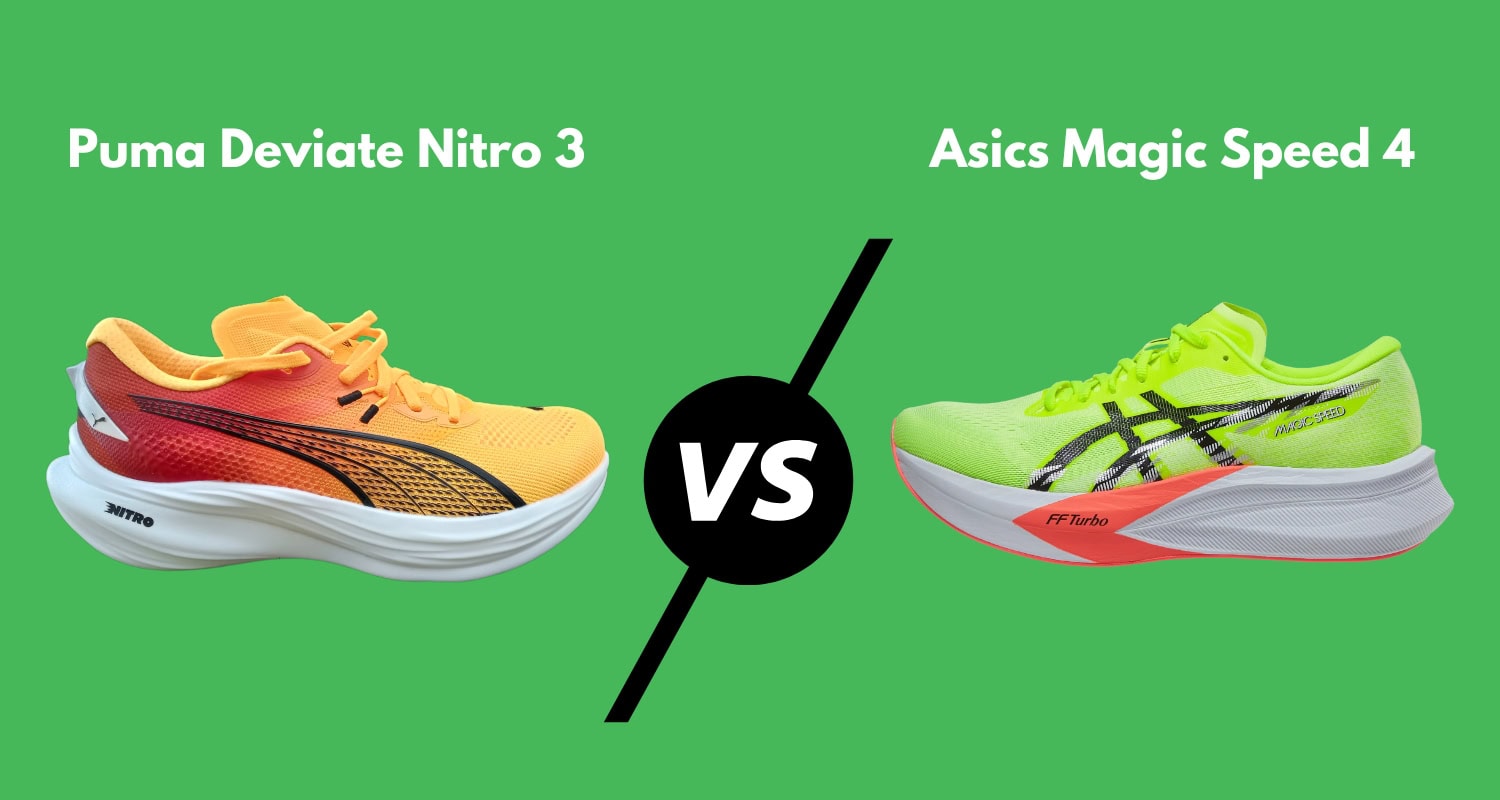
These two carbon-plated shoes are designed for performance-seeking runners, but each takes a different approach. Between Puma’s elegant design and Asics’ proven technology, which one best matches your running style?
Comfort
The Puma Deviate Nitro 3 uses a foam sandwich with the PWRPLATE carbon plate nestled between NITRO foam below and NITRO ELITE foam above. This setup offers balanced impact cushioning but remains less aggressive than its Elite version. With a 39mm heel and 29mm forefoot, it features a classic 10mm drop.
The Asics Magic Speed 4 goes further with impressive maximalist dimensions: 42.5mm in the heel and 35.5mm in the forefoot, for a 7mm drop. Its sole combines FF Blast Plus foam with a FF Turbo block in the forefoot. The ride feels rather firm but effective, with some testers finding it even too rigid.
Responsiveness
The Asics delivers better bounce thanks to the FlyteFoam Turbo insert. This high-performance foam provides more pronounced energy return than Puma’s configuration. Weight-wise, the Asics Magic Speed 4 is significantly lighter at 8.1 oz/231g compared to 9.5 oz/268g for the Puma in men’s size 9.
This is a meaningful difference that you’ll notice on long distances and during speed sessions. The Magic Speed 4 has gained weight compared to its previous version but remains slimmer than the Deviate.
Foot Lockdown
The Puma Deviate Nitro 3 features an engineered mesh upper with PWRTAPE reinforcements for support. Its fit runs rather narrow – something to consider for wide-footed runners. Breathability is decent but not exceptional, which might be problematic in hot weather.
The Asics Magic Speed 4 uses a multidirectional Engineered Mesh offering better fit – more precise and stretchable. Breathability is excellent. Its gusseted tongue and heel counter ensure good lockdown without excessive compression. It fits true to size, unlike the Puma which might require going up half a size.
Grip and Use Scenarios
Both shoes use quality rubber – PUMAGRIP for the Deviate Nitro 3 and ASICSGRIP for the Magic Speed 4. Grip is excellent on both models, even on wet surfaces.
For usage, the Puma is more versatile, better suited to easy-paced runs. The Asics is clearly speed-oriented, excellent for fast workouts and races. Both work for long distances, but the Asics is probably more suitable for marathons thanks to its lighter weight.
Deviate Nitro or Magic Speed: Which to Choose?
If you’re looking for a versatile carbon-plated shoe for varied training, go with the Puma Deviate Nitro 3. Its balanced cushioning and good shock absorption make it accessible for most runners.
Choose the Asics Magic Speed 4 if you prioritize lightness and responsiveness. More technical and firmer, these shoes will suit experienced runners seeking pure performance. Their superior breathability is also an asset for racing in hot weather.
Either way, you’ll get an excellent carbon-plated training shoe – your choice will mainly depend on whether you prefer dynamic firmness (Asics) or comfortable versatility (Puma).
|
9.3  |
9.4  |
|
|---|---|---|
| Overview | ||
| Description | The Puma Deviate Nitro 3 is a carbon plate shoe for comfortable and accessible daily training. | The Asics Magic Speed 4 is a fast trainer with a carbon plate. |
|
9.5
9.5
9
9
9
9.5
9.5
|
9.5
9.5
9.5
9.5
9.5
9
9.5
| |
| Facts | ||
| Terrain | Road | Road |
| Support | Neutral | Neutral |
| Heel stack height | 39 mm | 42.5 mm |
| Forefoot stack height | 29 mm | 34.5 mm |
| Heel-to-toe drop | 10 mm | 7 mm |
| Weight (men) | 268 g | 231 g |
| Weight (women) | 250 g | 207 g |
| Features | Carbon-fiber plate, Recycled materials, Rocker | Carbon-fiber plate, Vegan, Heavy runner, Recycled materials |
| Athletes | ||
| Release year | 2024 | 2024 |
| Technologies | ||
| Outsole | PUMAGRIP | ASICSGRIP |
| Midsole | NITRO, NITRO Elite, PWRPLATE | FLYETEFOAM BLAST PLUS, FLYTEFOAM TURBO |
| Upper | Engineered Mesh, PWRTAPE | Engineered Mesh |
| Cushioning | ||
| Cushioning | Balanced | Firm |
| Responsiveness | High | High |
| Use | ||
| Distance | Mid, 10K, Half marathon, Long, Marathon | Mid, 10K, Half marathon, Long, Marathon |
| Speed | Moderate, Fast | Moderate, Fast |
| Workouts | Daily running, Racing | Daily running, Racing |